
If you're building a home calisthenics setup, you've probably landed on these two pieces of equipment and wondered which one actually deserves your money first. They solve different problems — and picking the right one for where you are right now will get you results a lot faster than grabbing whichever one looks cooler in the Instagram ad.
Here's how to think about it.
What a Dip Belt Actually Does
A dip belt is a progressive overload tool. It doesn't teach you a new skill — it makes the skills you already have harder, on purpose, so you keep getting stronger.
If you can already do bodyweight dips, pull-ups, or squats comfortably, your muscles have adapted to that load and stopped being challenged by it. A dip belt lets you hang extra weight from your hips so you can keep adding resistance the same way a barbell lifter adds plates. No new coordination to learn, no new balance to figure out — just more weight, more strength.
Who it's for: you're already doing sets of 8-12+ bodyweight dips or pull-ups and want to keep progressing without switching your whole routine.
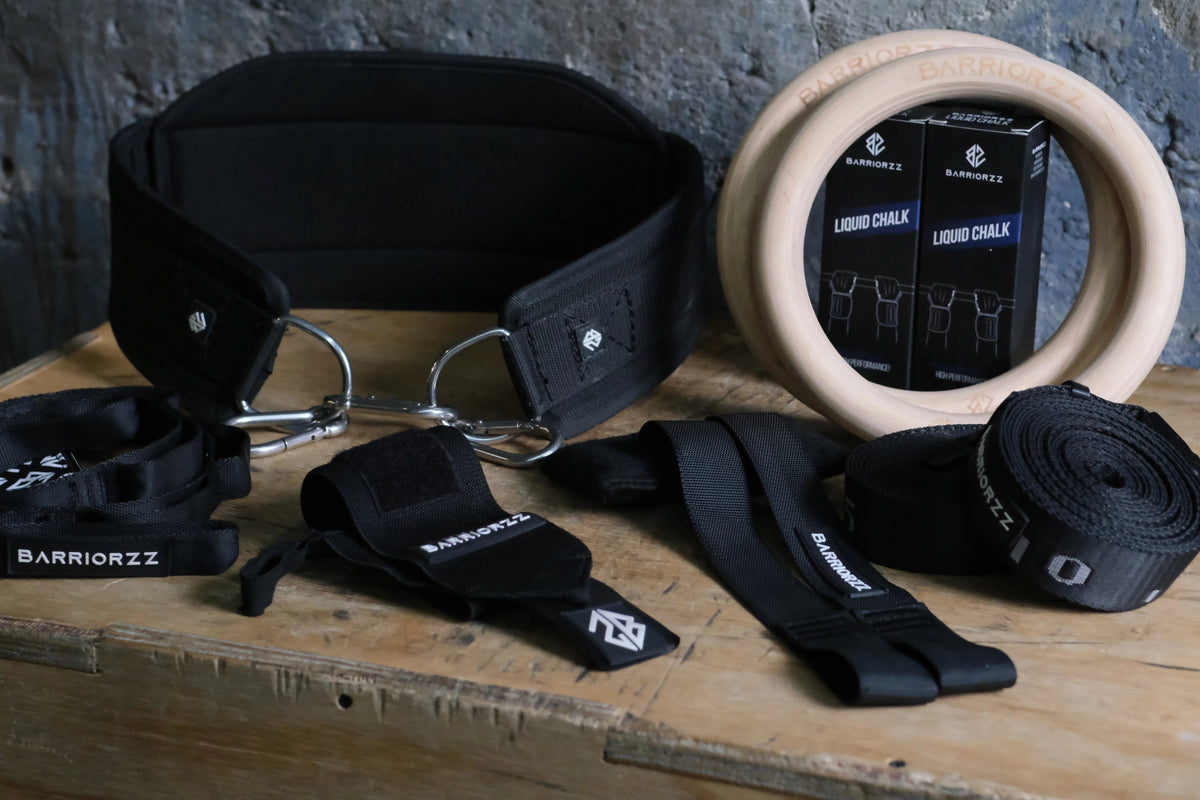
Our picks: the Dip Belt Pro and Premium Dip Belt — both built for stable loading with no swing or pinch during reps.
What Parallettes Actually Do
Parallettes solve a completely different problem: access. They're small elevated handles that let your hands do things flat ground won't let them do — get your hips higher than your hands, tuck your feet under you, or take pressure off your wrists.
That access unlocks an entirely different category of movement: L-sits, planche progressions, handstand pushups, dips with a deeper range of motion. These aren't strength problems you fix by adding weight — they're skill and positioning problems you fix by training the right shape, repeatedly, with the right setup.
Who it's for: you're working toward specific skills — L-sit, planche, handstand — or you find floor-based training limits your wrist mobility or range of motion.
A note if you've never tried them: most people who skip parallettes just haven't been introduced to what they unlock. It's less "do I need this" and more "I didn't know this was a category of training."
The Simple Decision Framework
| If you... | Get... |
|---|---|
| Find bodyweight dips/pull-ups/squats easy and want to keep getting stronger | Dip Belt |
| Want to build toward L-sits, planche, or handstand work | Parallettes |
| Have wrist pain from push-ups or floor work | Parallettes |
| Already have decent skill work but plateaued on strength | Dip Belt |
| Want to eventually do both (most people do) | Start with whichever matches your current goal — add the other in 2-3 months |
The Honest Answer
Most serious calisthenics setups end up with both eventually — they're not competing purchases, they're sequential ones. Start with the one that matches what you're training for right now, and don't feel like you're missing out on the other. You'll get there.
Ready to add one to your setup? Browse our Dip Belts and Parallettes collections.